I Walked Saigon's Alleys
The first thing you notice in Ho Chi Minh City is that the streets are alive.
Not alive in the way Delhi's streets are alive, with the desperate, honking, diesel-choked energy of twelve million vehicles fighting for thirty-three thousand kilometers of asphalt. Saigon's streets are alive the way a living room is alive. People sit on tiny plastic stools drinking ca phe sua da at six in the morning. A woman sells banh mi from a cart that she'll wheel away by noon, replaced by a man grilling corn until dusk. A grandmother watches her grandchild play in the alley while her daughter runs a nail salon from the ground floor of their four-meter-wide tube house.
I walked into a hem (one of Saigon's narrow alleys) for the first time in District 3, near Tao Dan Park. The address system is fractal: Hem 123/45/6 means you turn off the main street at address 123, then turn at sub-address 45 within that alley, then find building 6 in the sub-sub-alley. The alley was perhaps three meters wide. Motorbikes parked along one side. Potted plants lined the other. Laundry hung overhead. Someone had strung fairy lights between the buildings.
Eighty-five percent of Saigon's residents live in these alleys.1 Not in the broad French boulevards of District 1 or the gleaming towers of Phu My Hung. In the hem, the narrow, branching capillary network that constitutes the actual city. And they are not slums. The buildings are three to five stories tall, well-maintained, with cross-ventilation designed into the architecture. Every ground floor is a shop, a cafe, a workshop, a clinic. Every alley is a complete neighborhood, you can buy groceries, get a haircut, eat three meals, and never step onto a main road.
I stood in that alley and thought about my street in South Delhi. A wide road lined with compound walls. Gates. Guards. Air-conditioned cars pulling into underground parking. The nearest shop a fifteen-minute walk away, illegal, technically, because the zoning says "residential only." The wealthiest neighborhood in India's capital, and you cannot buy a cup of tea without getting into a car.
How did this happen? How did a city that was bombed, a city where 19 million gallons of herbicide were sprayed on its surrounding forests, where the Tet Offensive devastated entire districts, where 141,000 people were evacuated in a single chaotic day in 1975, become more livable than the capital of the world's largest democracy?
Delhi has the bigger metro system. The bigger economy. The bigger ambitions. It has spent thousands of crores on river cleanup, pedestrianization, urban renewal. And yet walking through Saigon's alleys, watching a city of 9.5 million people operate with a fluency and grace that Delhi (with all its resources) cannot match, the question wouldn't leave me alone.
This is the story of two cities shattered mid-century. One rebuilt itself into something livable. The other designed itself into suffocation.
Two Cities Broken
1947, 1975
Delhi's Wound
On the night of August 14, 1947, as Jawaharlal Nehru spoke of India's "tryst with destiny," the largest mass migration in human history was already underway. Partition split British India into two nations and split Delhi's soul in the process. Over the following months, approximately 500,000 Muslim residents left Delhi for Pakistan while a nearly equal number of Hindu and Sikh refugees arrived from what was now a foreign country.2
The refugees had nowhere to go. They camped in Humayun's Tomb, the sixteenth-century Mughal masterpiece became a tent city overnight. Purana Qila, the Old Fort built by Sher Shah Suri four centuries earlier, housed thousands. Kingsway Camp, the former staging ground for the Delhi Durbar, became one of the largest refugee settlements in history. Thirty percent of Delhi's population was displaced in a matter of weeks.
What followed was not reconstruction, it was improvisation. The refugee colonies that sprang up in the years after Partition, Lajpat Nagar, Greater Kailash, Defence Colony, Rajendra Nagar, Patel Nagar, became the template for how Delhi would grow for the next seven decades. Plots allocated, roads drawn, and then: build. No mixed-use planning. No ground-floor retail mandates. No attention to walkability or public space. Just residential blocks separated by roads built for a vehicle fleet that didn't yet exist but soon would.
The Delhi Development Authority was established in 1957, and the first Master Plan arrived in 1962, a top-down zoning document modeled on Western planning theory, enforced by a bureaucracy that had inherited the colonial government's power without its accountability. The DDA would control land acquisition, development, and allocation for the next six decades. It designated neat boxes on a map: residential here, commercial there, industrial elsewhere. Delhi's organic mixed-use fabric, the pattern that had made Shahjahanabad vibrant for 400 years, was declared illegal.
Saigon's Wound
Saigon's trauma was slower but no less devastating. The French colonial era ended at Dien Bien Phu in 1954, and the Geneva Accords partitioned Vietnam at the 17th parallel. Nine hundred thousand refugees fled south, many to Saigon. The city barely had time to absorb them before the American War began.
Between 1955 and 1975, Saigon's population tripled from 1.3 million to 3.3 million as rural Vietnamese fled the bombing campaigns in the countryside. The city that the French had designed as an elegant colonial capital (wide boulevards, tree-lined avenues, circular intersections modeled on Paris) was overwhelmed. Squatter settlements spread. Infrastructure collapsed under the weight.
Then came the Tet Offensive of 1968, which devastated Cholon, the ethnic Chinese district. And the herbicide campaigns: 19 million gallons of Agent Orange sprayed across 20% of Vietnam's forests, the largest chemical warfare program in history.3
On April 30, 1975, North Vietnamese tanks rolled through the gates of the Independence Palace. Saigon fell. 141,000 people were evacuated in the final days. The city was renamed Ho Chi Minh City. Over the next two decades, three million Vietnamese would flee as "boat people," many of them from this very city. It was, by any measure, a catastrophe more acute than Delhi's Partition experience.
And then came the dark decade. From 1975 to 1986, the reunified Vietnamese government imposed collectivization. Private property was confiscated. Businesses were nationalized. The economy stagnated. Saigon's population barely grew, there was nothing to grow toward. If you had visited both cities in 1985, you would have bet everything on Delhi. India was poor but stable, with a functioning (if sluggish) democracy and a slowly expanding middle class. Saigon was wrecked, physically, economically, psychologically.
The Parallel
- 500,000 refugees overnight
- 30% population displaced
- Camps in heritage monuments
- Refugee colonies reshaped geography
- Top-down planning imposed (DDA 1957)
- 141,000 evacuated in final days
- Population tripled during war
- Entire districts devastated
- 3 million fled as boat people
- Collectivization imposed (1975-86)
Both cities absorbed massive traumatic population shocks that broke their planned urban fabric. Both entered a period of desperate improvisation. Both had to rebuild from zero. What happened next is where the story diverges.
Population Growth: 1940-1980
Two Reforms, Two Paths
1986, 2000
In the mid-1980s, both countries faced economic crisis. Both responded with sweeping reform. But the reforms were fundamentally different in one critical respect: Vietnam reformed its cities. India did not.
Doi Moi, Vietnam's Renovation
In December 1986, Vietnam's Communist Party adopted Doi Moi, literally "renovation." It was a comprehensive economic transformation: market pricing replaced central planning, private enterprise was legalized, foreign investment was welcomed. But crucially, and this is the detail that explains everything that follows, Doi Moi reformed land and urban planning alongside economic policy.
Property rights were formalized. Land markets were created from scratch. Urban planning was decentralized to city governments. Ho Chi Minh City was given the authority to enter joint ventures with foreign developers, to issue land-use certificates, to approve master plans for new districts. The city became the agent of its own transformation.
The results were immediate. The first economic zone in HCMC opened in 1991. Foreign direct investment flooded in. Between 1986 and 2000, Vietnam's GDP growth jumped from 3.8% to 7.4% annually. By 2019, Vietnam had 343 industrial zones across the country.4 But the economic miracle was built on an urban foundation, land reform, planning reform, and governance reform gave cities the tools to absorb and direct the growth.
India's 1991, The Half-Reform
Five years after Doi Moi, India faced its own crisis. Foreign exchange reserves hit rock bottom. The IMF bailout came with conditions. In July 1991, Finance Minister Manmohan Singh opened India's economy to the world: industrial licensing was abolished, trade barriers fell, foreign investment was welcomed.
It was a transformative moment for Indian industry and commerce. But it left one domain entirely untouched: India's cities.
The 74th Constitutional Amendment of 1992 was supposed to be India's urban governance reform. It mandated elected municipal governments with genuine planning powers. On paper, it was revolutionary. In practice, implementation lagged for decades. State governments retained control of land, planning, and development authorities. The DDA kept its monopoly over Delhi's land. Parastatal agencies (unelected, unaccountable, colonial in origin) continued to make the decisions that shaped how millions of people lived.
India liberalized its economy but left its cities in the hands of colonial-era planning bureaucracies. This is the original sin.
India liberalized its economy but left its cities in the hands of colonial-era planning bureaucracies. Vietnam reformed both. That single difference explains the next three decades.
The Test Case: Phu My Hung vs. Dwarka
If you want to see the divergence in concrete (literally), compare two planned districts built on blank land in the same decade.
Phu My Hung, District 7, HCMC. Founded in 1993 as a joint venture: CT&D Corporation (Taiwan) held 70%, the HCMC government held 30%. The master plan was designed by Skidmore, Owings & Merrill and Kenzo Tange Associates, two of the world's most respected urban design firms. The result: 2,630 hectares of compact, walkable neighborhoods with continuous ground-floor retail, waterway networks, and approximately 40% green space. In 2008, Vietnam's Ministry of Construction designated it a "Model Urban Area."5
Dwarka, Southwest Delhi. Developed by the DDA as a planned sub-city, also in the 1990s. Twenty-three numbered sectors, standard DDA planning: wide roads, separate residential and commercial zones, conventional block layouts. For years, the sub-city lacked basic water and sanitation infrastructure. There was no street life, commercial activity was segregated into designated "market areas." Real transformation came only when the Blue Line Metro arrived in 2005, providing the connectivity that the planning had failed to create.
| Phu My Hung (Saigon) | Dwarka (Delhi) | |
|---|---|---|
| Founded | 1993 | 1990s |
| Governance | International JV (Taiwan 70%, HCMC 30%) | DDA monopoly |
| Master Plan | SOM + Kenzo Tange Associates | Standard DDA planning |
| Area | 2,630 hectares | ~5,600 hectares (23 sectors) |
| Ground-Floor Retail | Continuous, every street active | Segregated into "market areas" |
| Green Space | ~40% of development | Minimal parks, wide roads |
| Walkability | Designed walkable from day one | Car-dependent; rescued by Metro (2005) |
| Recognition | "Model Urban Area" (2008) | "Largest planned sub-city in Asia" |
The comparison is not about resources. It's not about population. It's not about culture or climate or geography. Phu My Hung was built on marshland in a country with a per-capita GDP of $400. Dwarka was built on allocated land in a country with twice the resources. The difference was governance: one city had the authority and the incentive to build well. The other was stuck with a planning bureaucracy that had no competition, no accountability, and no vision beyond reproducing colonial templates.
This is the thesis of this article. The gap between Delhi and Saigon isn't resources or population, it's that Vietnam reformed urban governance and India didn't.
Saigon Today, What They Built
Saigon is not a utopia. The traffic is chaotic, the air quality middling, the public green space a dire 0.55 square meters per person. But it got five things right that Delhi got catastrophically wrong, and understanding those five things is the key to imagining a different Delhi.
4.1 The Tube House nha ong
The Vietnamese tube house is one of the most successful mixed-use building typologies in the world, and it was an accident of colonial taxation.
Under French rule, property taxes were levied based on street-facing width. Landowners responded rationally: they built narrow and deep. The typical tube house is 3 to 5 meters wide and 20 to 30 meters deep, rising 3 to 5 stories. The ground floor is always commercial, a shop, a cafe, a workshop, a clinic. The upper floors are residential. Light wells in the center provide ventilation. Rooftops are gardens, laundry spaces, social areas.
The result is that virtually every residential street in Saigon is also a commercial street. There is no zoning distinction between "where you live" and "where you shop." The tube house is mixed-use by architecture, not by regulation. A grandmother can sell pho from her ground floor in the morning and close the shutters in the afternoon. A tailor can run a workshop at street level and sleep two floors above. The boundary between domestic and commercial life is a roll-down metal door.
The tube house is also, almost accidentally, a thermal masterpiece. The central light wells that provide ventilation to the deep floor plates also create a stack effect, hot air rises through the well and escapes from the roof, drawing cooler air in through the ground-floor opening. The narrow width means that neighboring buildings shade each other for most of the day. Walk through a hem at noon in April, when Saigon's temperature hits 38°C, and the alley is ten degrees cooler than the boulevard you just left. The shade is continuous, the airflow constant, the cooling passive.
This is not nostalgia for pre-modern building. It is physics. Narrow streets self-shade. Deep floor plans ventilate through stack effect. Light wells move air without electricity. The tube house achieves thermal comfort in a tropical city without the air-conditioning loads that make modern glass towers in Delhi and Dubai ecological disasters. When climate scientists talk about "passive cooling strategies for tropical cities," they are describing what Vietnamese builders figured out under French colonial tax policy.
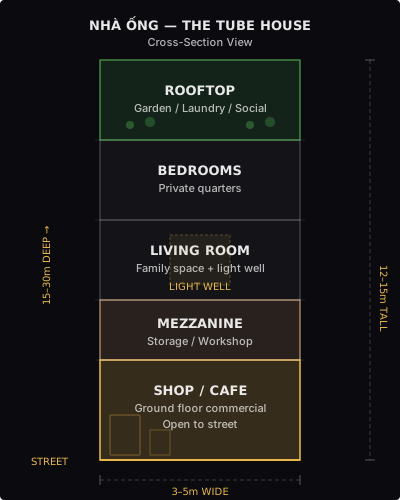
Compare this with Delhi's zoning regime. In South Delhi's wealthy colonies (Greater Kailash, Defence Colony, Vasant Vihar) running a business from your ground floor is illegal. The Master Plan designates these areas as "residential." If you want to buy groceries, you drive to a designated market. If you want a cup of tea, you walk fifteen minutes to the nearest authorized commercial establishment, if one exists. The streets are dead because the zoning mandates their death.
The tube house proves that mixed-use doesn't require complex regulations or progressive politics. It just requires not banning it.
The tube house also creates a gradient of economic formality that no zoning code could design. The ground-floor shop is the formal layer, registered, taxed, visible. Just outside, a semi-formal vendor sets up a cart under the overhang, paying informal rent to the shop owner. On the sidewalk beyond, a woman with a basket sells fruit from a cloth on the ground. Three layers of economic activity, formal, semi-formal, informal, coexisting within five meters. Annette Kim's Sidewalk City documents this layered economy in granular detail: the sidewalk in Saigon is not empty space waiting to be regulated, but a productive landscape with its own spatial logic.17
This is not to say that Saigon's relationship with street vendors is frictionless. Between 2017 and 2019, HCMC launched aggressive sidewalk-clearing campaigns, metal barriers went up, vendors were fined, carts were confiscated. The campaigns generated backlash and ultimately subsided. The fundamental integration survived because the tube house architecture demands it: when your building is three meters wide and your livelihood depends on the foot traffic in your alley, you don't ban the vendors who generate that traffic. The building form protects the economic ecosystem.
4.2 The Hem Network
If the tube house is Saigon's building unit, the hem is its street unit. And it is perhaps the most underappreciated urban infrastructure on earth.
A hem is a narrow alley (typically 1.5 to 4 meters wide) that branches off a main road and penetrates deep into the block interior. The alleys subdivide fractally: a major hem might contain ten sub-alleys, each containing five more. The addressing system reflects this branching: Hem 123/45/6 is building 6, in sub-alley 45, off alley 123. It reads like a file path, and the analogy is apt, the hem network is a file system of urban life.
Eighty-five percent of HCMC's residents live in hem. The density in some central alleyway neighborhoods exceeds 80,000 inhabitants per square kilometer, higher than anywhere in Delhi except the densest parts of Old Delhi. Yet these are not slums. The hem supports a complete 15-minute neighborhood: groceries, street food, barbershops, clinics, schools, temples, small workshops, all within a three-minute walk. Motorbikes navigate the alleys slowly, yielding to pedestrians. Cars simply cannot enter. The hem is pedestrian-priority by physics, not by policy.
What makes the hem remarkable for housing equity is that the poor and the middle class live in the same alleys. A family earning $300 a month rents a second-floor room in a tube house whose ground floor is a motorcycle repair shop. Their neighbor earns ten times more and owns the building next door. The physical infrastructure (water, electricity, drainage, the alley itself) serves both households identically. There is no spatial segregation by income. No gated community for the affluent, no resettlement colony for the poor. The hem integrates by default because the building typology doesn't distinguish between income levels, it distinguishes between floors.
This is not to claim that Saigon has no poverty or no displacement. Some of the city's most vulnerable residents lived in informal settlements along the Nhieu Loc and other canals, approximately 7,000 families were relocated during the canal restoration, with compensation packages and resettlement housing provided under World Bank oversight. But the relocation was from waterway banks into the hem network itself, the poor were moved into the city, not to its periphery. The default condition in Saigon is spatial integration. The default condition in Delhi, as we will see, is spatial apartheid.
The genius of the hem is that it solves the last-mile problem that every city in the world struggles with. Delhi builds a magnificent Metro station and then strands its riders at the exit, no sidewalks, no shade, no connecting paths to the neighborhoods within. Saigon's hem network connects every residence to every main road through a continuous web of walkable paths. You step out of your door and you are already on a street that leads somewhere.
4.3 Nguyen Hue Boulevard
Nguyen Hue Boulevard has been reinvented three times. Each reinvention tells you something about the city that made it.
Originally, it was a canal, part of the waterway network the French found when they colonized Saigon in the 1860s. In 1887, the French filled the canal and built Boulevard Charner, a wide European-style avenue. For a century, it served as a vehicular thoroughfare: cars, motorbikes, buses.
Then, in April 2015, the city pedestrianized it. The project cost $19 million. Construction took six months. The result: a 670-meter pedestrian boulevard, 64 meters wide, with granite paving, misting systems, vegetation, and the Ho Chi Minh statue at one end.6
Nguyen Hue: The Numbers
The boulevard transformed District 1. Property values along the street doubled. The annual Tet flower festival draws millions. On weekend evenings, thousands of people gather, families, couples, street performers, food vendors. It became the cultural heart of the city. All for $19 million and six months of construction.
Remember those numbers. You'll need them when we get to Chandni Chowk.
4.4 Nhieu Loc-Thi Nghe Canal
In the 19th century, the Nhieu Loc-Thi Nghe canal was called the "white stream", clean enough to swim in, central to the city's waterway network. By the 1990s, it was an open sewer. Squatter settlements lined both banks. Raw sewage flowed directly in. The smell was legendary. Fish were a memory.
In 2002, HCMC launched the Environmental Sanitation Project, funded by the World Bank. Phase 1 cost $421 million. The scope was enormous: 7,000 families were relocated (with compensation and resettlement housing). An 8.9-kilometer sewer interceptor was built along the canal bed. Seventy kilometers of smaller sewers were connected. Green parks were created along both banks.7
The project took roughly a decade. By 2012, the canal was transformed. Fish returned. Kayaking began. Residents started using the banks for morning exercise. Local media began calling it "the Seine River in the heart of HCMC."
Phase 2, covering 1.2 million residents and extending the restoration further, is budgeted at $524 million. The combined investment (under $1 billion) restored a central waterway and created a linear park through the densest part of the city.
The Nhieu Loc project also addressed something that rarely gets mentioned in river restoration narratives: flooding. Before the interceptor sewer was built, every heavy monsoon rain backed up the canal system and flooded Districts 1, 3, and Binh Thanh, Saigon's commercial core. The interceptor didn't just divert sewage; it created hydraulic capacity for stormwater. Flood points in the restored canal zone dropped by over 60% in the decade following completion.23 The project was simultaneously sewerage, flood control, park creation, and property value uplift, four outcomes from one integrated investment, managed by one authority.
Saigon still floods, let's be honest about that. The city sits barely above sea level, and climate change is raising the stakes every year. But the Nhieu Loc model demonstrated that integrated infrastructure, where drainage, sewerage, and public space are designed as a single system rather than managed by separate agencies, produces results that siloed approaches cannot. The same dollar that cleans the canal also prevents the flood also creates the park. That integration is the lesson, not the perfection.
Remember those numbers too.
Nhieu Loc Canal: From Open Sewer to Urban Oasis
Nhieu Loc-Thi Nghe canal is one of the most polluted waterways in Southeast Asia. Squatter settlements line both banks. Raw sewage flows directly in. Fish are a memory.
DO: 0 mg/LHCMC launches the Environmental Sanitation Project. Phase 1 budget: $421 million. 7,000 families identified for relocation with compensation and resettlement housing.
$421M committed8.9 km sewer interceptor built along the canal bed. 70 km of smaller sewers connected. 7,000 families relocated with compensation, not demolition.
8.9 km interceptorGreen parks created along both banks. Canal water quality improves dramatically. Residents begin using the banks for morning exercise. The transformation becomes visible.
Parks on both banksThe canal is biologically alive. Fish swim in it. Kayaking begins. Local media calls it "the Seine River in the heart of HCMC." Flood points drop 60%.
DO: 4.2 mg/LPhase 2 covers 1.2 million residents. Budget: $524 million. The model is proven, and now it scales. Combined investment under $1 billion for a central waterway transformation.
$524M Phase 24.5 Metro Line 1
Saigon managed 9 million people with zero rail transit until December 2024. Let that sink in. Delhi had 392 kilometers of Metro. Saigon had motorbikes.
Metro Line 1 (the Ben Thanh to Suoi Tien line) was approved in 2007, originally budgeted at $1.3 billion, and was supposed to open in 2018. It opened on December 22, 2024, seven years late, at a cost of $2.1 billion.8 By any standard, it was over-budget and behind schedule.
But when it opened, 150,000 people rode it on day one. In its first two weeks, 1.7 million passengers used the system, 300% above target. On New Year's Day 2025, a single-day record of 275,144 riders was set. The 19.7-kilometer line, with 14 stations (3 underground, 11 elevated), demonstrated massive latent demand.
Two months later, construction began on Metro Line 2. The 54-kilometer Ben Thanh-Can Gio line broke ground in December 2025. Vietnam's full plan calls for 9 metro and interregional rail lines for HCMC. They started late, but they started.
This matters because it inverts the usual Delhi vs. Saigon comparison. Delhi partisans will point out (correctly) that Delhi's Metro is 20 times larger than Saigon's. But that comparison misses the point. Delhi built a world-class Metro and failed at everything else. Saigon built walkable streets, restored canals, pedestrianized boulevards, maintained mixed-use neighborhoods, and then added transit on top. Delhi's Metro is an island of competence in a sea of dysfunction. Saigon's Metro is the latest addition to a city that was already working.
Delhi Today, What We Built
Delhi is not a failed city. It is a city of extraordinary contradictions, a world-class Metro surrounded by unwalkable streets, ancient heritage districts choking on diesel, the most expensive land on the subcontinent occupied by one family and one guard per acre.
5.1 Old Delhi: Chandni Chowk
Shahjahanabad (Old Delhi) is 400 years of layered urbanism compressed into 6 square kilometers. Shah Jahan founded it in 1638 around the Red Fort, and the basic street pattern has barely changed since. The density ranges from 31,000 to over 100,000 people per square kilometer, depending on which ward you measure.9 It is one of the most intensely used urban spaces on earth.
It is also Delhi's greatest missed opportunity.
The pedestrianization of Chandni Chowk (the 1.3-kilometer stretch from the Red Fort to Fatehpuri Mosque) was first conceived in 2008. It took thirteen years to complete, opening in September 2021 at a cost of approximately Rs 100 crore ($12 million). The project used red sandstone paving, installed bollards to restrict vehicle access, and created a pedestrian promenade along the historic market street.
Within a year, the red sandstone started breaking under truck loads, trucks that weren't supposed to be there but returned when enforcement lapsed. By September 2024, when maintenance contracts expired, the Delhi High Court took suo motu notice of the "pathetic condition" of the pedestrianized stretch. Cracked tiles, litter, unlicensed rickshaws, the gradual return of unauthorized vehicles.10
| Nguyen Hue (Saigon) | Chandni Chowk (Delhi) | |
|---|---|---|
| Conceived | ~2010 | 2008 |
| Completed | April 2015 | September 2021 |
| Construction Time | 6 months | ~3 years (after 10 years of delays) |
| Cost | $19 million | ~$12 million (Rs 100 crore) |
| Current Condition | Thriving (annual Tet festival, property values doubled | Deteriorating) HC suo motu notice of "pathetic condition" |
| Governance | HCMC city government (single authority) | SRDC + PWD + MCD + 2 police departments |
The root cause is not the sandstone or the design or the budget. Saigon's Nguyen Hue was managed by one authority, the HCMC city government. Chandni Chowk's pedestrianization involved the Shahjahanabad Redevelopment Corporation, the Public Works Department, the Municipal Corporation of Delhi, and two separate police departments. Five agencies, zero accountability, and a maintenance contract that nobody renewed.
Old Delhi's galis (its narrow alleys) are the closest thing India has to Saigon's hem. They are mixed-use, dense, walkable, commercially vibrant. Khari Baoli, Asia's largest spice market, operates from lanes barely wider than a cart. These streets work despite the planning regime, not because of it. They are illegal in the same way that Saigon's tube houses would be illegal under Delhi's zoning code, which is to say, they are the actual city, and the zoning code is the fiction.
5.2 Lutyens' Delhi: The Colonial Fossil
In the geographic center of India's capital, there are 26 square kilometers occupied by approximately 20,000 people. That's a density of 770 people per square kilometer, village density, in the heart of a city of 22 million.
Lutyens' Delhi, the bungalow zone designed by Edwin Lutyens and Herbert Baker for the British Raj, inaugurated in 1931, is the most expensive land on the Indian subcontinent. The Floor Area Ratio here is 15 to 25, meaning you can build approximately one-fifteenth of the land area.11 One bungalow. One family. One guard. Surrounded by a compound wall, set back from a wide road, invisible to the city.
The wide, tree-lined avenues are beautiful. The canopy is genuinely magnificent, some of the finest urban tree cover in Asia. But beauty does not excuse waste. These 26 square kilometers could house 200,000 people at moderate mid-rise density (6-8 stories) while preserving every single tree. They could support ground-floor retail, neighborhood cafes, walkable streets, the kind of urban life that makes Saigon's District 3 one of the most pleasant neighborhoods in Southeast Asia.
Instead, they house the political class that inherited the bungalows from the British, and the bureaucratic class that protects their privilege through zoning law. Lutyens' Delhi is a colonial fossil, maintained by post-colonial elites, at the cost of a city that desperately needs the land.
5.3 Connaught Place: Designed for Walking, Built for Cars
Robert Tor Russell designed Connaught Place in 1929 as a Georgian crescent, colonnaded walkways, radial streets, a central park. It was designed for pedestrians. You were meant to walk under the colonnades, moving between shops, cafes, and offices in the shade of a continuous arcade.
Today, the outer circle is a diesel ring road. The inner circle is a parking lot. The colonnades (those beautiful, shaded walking galleries) are shortcuts for cars turning between radial roads. Half a million Metro riders pass through Rajiv Chowk station daily, the busiest in the network, and emerge into a landscape hostile to human presence.12
There is no reason to linger above ground at Connaught Place. The underground Palika Bazaar has more commercial energy than the heritage arcade above it. The central park is fenced. The fountains are dry. A building designed by one of the finest architects of the British Raj (a building that shares DNA with Bath's Royal Crescent and London's Regent Street) has been surrendered to the automobile.
Nguyen Hue was a vehicular road turned into a pedestrian boulevard for $19 million in 6 months. Connaught Place was a pedestrian arcade turned into a vehicular nightmare over 90 years. The same transformation, in reverse.
5.4 South Delhi: Rich Streets, Dead Streets
Greater Kailash. Hauz Khas. Defence Colony. Vasant Vihar. Panchsheel Park. These are the wealthiest residential neighborhoods in India's capital. The per-square-foot property rates rival Manhattan. The residents are the country's elite, politicians, industrialists, senior bureaucrats, media figures.
And the streets are dead.
Walk through Greater Kailash Part I on a Tuesday afternoon. High compound walls on both sides. Iron gates. A guard sitting on a plastic chair. The occasional SUV pulling in or out. No shops. No cafes. No trees providing shade over a sidewalk (there are often no sidewalks). No children playing. No people, period.
This is by design. The Master Plan zones these areas as "residential." Ground-floor commercial activity is illegal. A corner shop is a zoning violation. A cafe operating from a house is unauthorized. The street life that exists in South Delhi, the cafes of Hauz Khas Village, the restaurants of Khan Market, the boutiques of Shahpur Jat, exists only where zoning has been violated.
Khan Market, regularly cited as one of the most expensive retail streets in the world, is technically illegal. It was a refugee market established after Partition, never properly zoned for commercial activity in the original DDA framework. The irony is perfect: Delhi's most valuable commercial street exists because of a humanitarian crisis that overrode the planning code. If the DDA had been faster in 1948, Khan Market would be another dead residential colony.
The irony deepens when you consider Khan Market's origin. It began as informal refugee commerce, displaced families selling goods from makeshift stalls. The same improvised street life that made Khan Market one of the world's most expensive retail addresses is precisely what Delhi's planning regime now criminalizes everywhere else. The Street Vendors (Protection of Livelihood and Regulation of Street Vending) Act of 2014 was supposed to change this, it mandated Town Vending Committees, vendor surveys, designated vending zones, and protection from arbitrary eviction.24
The Act remains largely unimplemented. MCD demolition drives continue with regularity, carts confiscated, stalls dismantled, vendors beaten. Licensed vendors are a fraction of the actual vendor population. The survey mandated by the Act has never been completed in most zones. The same governance failure that kills streets through single-use zoning also criminalizes the vendors who could revive them. Delhi simultaneously bans ground-floor commerce and punishes the informal merchants who fill the gap.
In Saigon's tube house neighborhoods, the vendor is the connective tissue between the building and the street. In Delhi's colonies, the vendor is a criminal. The zoning code doesn't just prohibit commercial activity from happening inside buildings, it criminalizes the human beings who bring commercial activity to the street itself.
In Saigon, the vendor is not a parasite on the street, she is the street.
The street life that exists in South Delhi exists only where zoning has been violated. Khan Market, one of the most expensive retail streets in the world, is technically illegal.
There is a consequence of dead streets that urban planning textbooks discuss in the abstract but that women in Delhi experience in their bodies every day. Jane Jacobs wrote it in 1961: "A well-used city street is apt to be a safe street. A deserted city street is apt to be unsafe." She called it "eyes on the street", the natural surveillance that comes from ground-floor shops, from vendors, from residents who can see the sidewalk from their windows. Mixed-use streets are safe streets because there is always someone watching.21
Walk through Greater Kailash at 9 PM. The compound walls are six feet high. The guards are inside the gates, not on the street. There are no shops open, there are no shops, period. No vendors. No cafe patrons sitting on a terrace. The street lighting, where it exists, illuminates empty asphalt. A woman walking alone on this street is invisible to everyone except whoever else is on that street. Delhi recorded over 14,000 crimes against women in 2023, the highest of any Indian city.21 We discuss this as a policing problem, a cultural problem, an education problem. It is also, fundamentally, a zoning problem.
Saigon's hem alleys at 9 PM are the opposite. Someone is always awake. A noodle shop is serving late diners. A grandmother sits in her doorway. A motorcycle repair shop has its roller door half-open. A woman walking through a hem at midnight passes thirty pairs of eyes, not surveillance cameras, not police patrols, but residents whose daily life intersects with the public space of the alley. This is not cultural. Vietnamese society is not inherently more protective of women. It is architectural. The tube house puts living rooms at street level. The hem makes the street an extension of the home. Eyes on the street is a design outcome, not a moral achievement.
Empty streets are not peaceful streets. They are dangerous streets. Every compound wall that hides a family from the sidewalk removes a pair of eyes that could keep a woman safe.
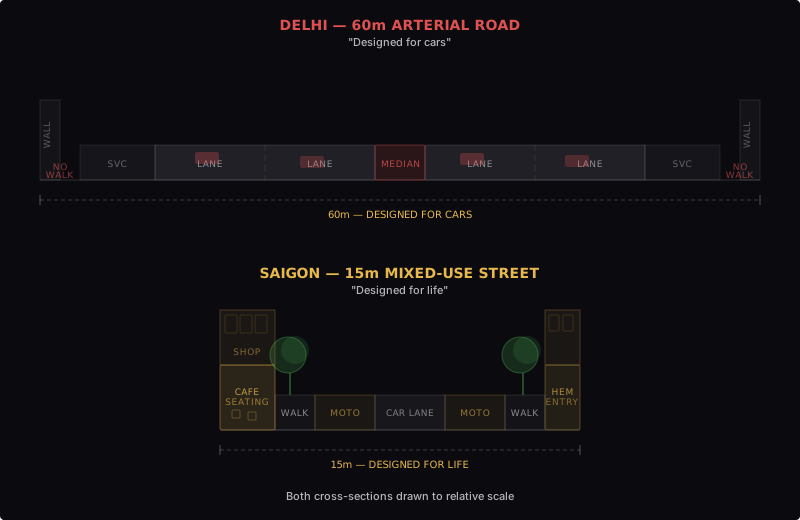
Look at that cross-section again and think about heat. In May 2024, Delhi recorded 49°C, the highest temperature ever measured in the city, and among the highest ever recorded in any major world capital.22 The heat island effect in South Delhi's wide-road, compound-wall neighborhoods is brutal: asphalt absorbs solar radiation all day and re-emits it all night, compound walls block cross-ventilation, and the absence of street trees means zero shade canopy over the pedestrian zone. A 60-meter-wide arterial road is not a street, it is a heat corridor, radiating stored thermal energy into a neighborhood that has no passive cooling strategy whatsoever.
Saigon is also hot, it sits 10 degrees closer to the equator. But its peak temperatures rarely exceed 39°C because the urban fabric itself provides cooling. Narrow alleys self-shade by mid-morning. Tube house light wells create convective airflow. The dense canopy of the hem, potted plants, overhanging trees, laundry lines that inadvertently create shade, reduces ground-level temperatures by 5-8°C compared to nearby boulevards. Delhi's street cross-section is designed to move cars at speed. Saigon's is designed, by accident and by physics, to keep humans alive in tropical heat.
5.5 The Yamuna: Rs 8,000 Crore of Failure
The Yamuna is biologically dead.
Not metaphorically, not in the exaggerated language of environmental activism, literally dead. In January 2025, dissolved oxygen readings in the 22-kilometer Delhi stretch hit zero. Fecal coliform counts reached 8.4 million MPN per 100 milliliters, the safe bathing limit is 500. Biological oxygen demand was 70 mg/L; the safe standard is 3. Toxic foam accumulated at Kalindi Kunj, visible from satellite imagery.13
India has spent over Rs 8,000 crore (approximately $1 billion) across three Yamuna Action Plans spanning three decades. Phase I (1993): Rs 770 crore. Phase II (2004): Rs 1,656 crore. Phase III: approximately Rs 2,500 crore more. The money was spent. The sewage treatment plants were built, 37 of them. But only 14 meet discharge standards. And the fundamental problem was never addressed: two drains, Najafgarh and Shahdara, contribute 84% of the pollution load, and intercepting them would require political will that no government has mustered.14
The same Najafgarh and Shahdara drains that poison the Yamuna also flood the city every monsoon. ITO underpass, Minto Bridge, the Ring Road near AIIMS, the same locations fill with water every July, year after year, trapping buses and drowning motorists. These are not freak events; they are scheduled infrastructure failures. The drains that carry sewage into the Yamuna during the dry season back up during the rains because the system has no surge capacity. Flooding and river pollution are not two problems, they are the same problem, viewed from different seasons, managed by different agencies who do not coordinate.
In Saigon, the Nhieu Loc interceptor was designed as both a sewage conduit and a flood-control channel, one piece of infrastructure solving both problems because one authority was responsible for both outcomes. In Delhi, the Yamuna is the Delhi Jal Board's jurisdiction, the drains are MCD's, the flood response is the District Magistrate's, and the river cleanup is the National Mission for Clean Ganga's. Four agencies, four budgets, four mandates, and 30 to 40 flood points that reappear with metronomic regularity every monsoon.
River Restoration: Yamuna vs. Nhieu Loc
Compare: Nhieu Loc Canal in Saigon was an open sewer. $421 million and one decade later, fish swim in it. People kayak. The banks are parks. The difference is not money, Delhi spent more. The difference is governance: one authority, clear accountability, World Bank oversight, and the political will to relocate 7,000 families (with proper compensation) who were living along the canal.
Delhi's Yamuna isn't a river anymore. It's a monument to governance failure.
5.6 Delhi Metro: The Exception That Proves the Rule
In the midst of all this dysfunction, Delhi built one of the largest metro systems in the world.
Phase I was completed ahead of schedule and within budget, a feat so rare in Indian infrastructure that it became a national legend. E. Sreedharan's Delhi Metro Rail Corporation operated with a degree of autonomy, accountability, and technical competence that was anomalous in Delhi's governance landscape. The network now spans 392 kilometers across 285+ stations on 11 lines, carrying approximately 4.63 million passengers daily.15
The Delhi Metro proves something crucial: this city is not incapable of world-class execution. The problem is not Indian governance in the abstract, or Delhi's culture, or some inherent dysfunction. The problem is that the Metro succeeded because it was given autonomous institutional structure, insulated from the fragmented, multi-agency chaos that governs everything else.
Streets? That's PWD, plus MCD, plus the traffic police, plus the DDA. Parks? That's DDA, plus MCD, plus the Forest Department, plus the Ridge Management Board. The Yamuna? That's the Delhi Jal Board, plus CPCB, plus DPCC, plus the National Mission for Clean Ganga, plus the National Green Tribunal. For every problem, five agencies. For every agency, zero accountability.
The Metro had one agency: DMRC. One leader: Sreedharan. One mandate: build the system. That's why it worked.
The lesson is not that Delhi needs more Metros. The lesson is that Delhi needs the Metro's governance model applied to streets, to rivers, to public space, to the city itself.
5.7 Air Quality: The Zoning Tax You Breathe
Every winter, Delhi disappears. The AQI crosses 400, "severe plus," a category that exists only in India because no other country needed one. Schools close. Construction halts. Flights divert. The Supreme Court intervenes. And every spring, the city forgets, until the next November when the smoke returns.
The usual culprits are cited: stubble burning in Punjab, construction dust, Diwali firecrackers, vehicular emissions. All real. But the underlying driver, the one that makes Delhi's air permanently worse than cities with similar traffic and industrial profiles, is the zoning regime itself. Single-use residential zones force every trip into a car. When the nearest grocery store is a 15-minute drive because ground-floor retail is illegal, you generate vehicle-kilometers that a mixed-use neighborhood would eliminate. When every school run, every doctor's visit, every cup of tea requires an engine, the aggregate emissions are not a traffic problem, they are a land-use problem.16
Saigon's air quality is far from pristine, the motorbike fleet is largely two-stroke, and industrial zones on the city's periphery contribute particulate matter. But HCMC's average AQI hovers around 95, roughly a third of Delhi's. The motorbikes are individually dirtier, but the trips are shorter. When you live in a hem where the grocer is 30 seconds away and the school is a 5-minute walk, you don't generate the vehicle-kilometers that Delhi's residents do. The motorbike gets you to work and back, 4-5 km in a city where everything is mixed-use and close together. Delhi's SUVs travel 15-20 km for errands that Saigon's residents accomplish on foot.16
Delhi's Metro was supposed to fix this. In isolation, it has, Metro riders avoid millions of car trips daily. But the Metro deposits riders into neighborhoods where the last mile requires an auto-rickshaw or an Uber, because the land use around the station is single-use residential with no walkable destinations. Transit-oriented development remains a planning document aspiration, not a built reality. The Metro is a clean artery feeding a polluted body.
Air Quality: Delhi vs. Saigon
5.8 The Urban Poor: Spatial Apartheid
Delhi has approximately 700 JJ (Jhuggi-Jhopri) clusters, informal settlements housing between 1.7 and 2 million people, depending on which estimate you trust. It also has 1,731 "unauthorized colonies", settlements that grew outside the Master Plan framework, many now decades old with concrete buildings and established communities, housing millions more. And it has 362 "regularized-unauthorized" colonies that exist in a legal limbo, recognized enough to receive water and electricity, but not recognized enough to receive property titles.19
The land paradox is staggering. Lutyens' Delhi houses approximately 20,000 people on 26 square kilometers, a density of 770 per square kilometer. Some JJ clusters exceed 200,000 people per square kilometer, more than 250 times the density, often within walking distance of the bungalow zone. The most expensive land in India sits virtually empty while the poorest residents pack into densities that no infrastructure can support. This is not a housing shortage, it is a distribution catastrophe enforced by zoning law.20
The DDA's historical response to JJ clusters has been demolition. Between 1990 and 2015, tens of thousands of jhuggis were razed, often without adequate resettlement, often to clear land for infrastructure projects or real estate development. The "in-situ rehabilitation" model that the Master Plan 2041 now proposes has been piloted at Kathputli Colony and a handful of other sites, but progress is glacial and the displacement during construction pushes residents into other informal settlements, solving nothing.
In Saigon, poverty exists, but it is not spatially segregated in the same way. The hem network integrates low-income families into the same alleys as middle-class residents. A family renting a room above a workshop in District 4 uses the same water supply, walks the same alley, sends children to the same neighborhood school as the tube house owner next door. The slum population of HCMC is estimated at roughly 5%, a third of Delhi's proportion, not because Vietnam is richer (it isn't) but because the urban form itself doesn't push the poor to the periphery.
Where the Poor Live
- ~700 JJ clusters (1.7-2M people)
- 1,731 unauthorized colonies
- Demolition as default policy
- Spatial segregation: slums vs. bungalows
- Lutyens' at 770/km² vs JJ at 200,000/km²
- Poor live inside the hem network
- Mixed-income alleys by default
- Canal relocations with compensation
- Spatial integration: floors, not zones
- ~5% slum population vs Delhi's ~15%
Delhi's poverty is a spatial condition enforced by zoning, the poor are pushed to wherever the Master Plan didn't reach. Saigon's poverty exists within the same urban fabric as the middle class, because the building form doesn't distinguish between income levels.
The Data, Decade by Decade
Strip away the narrative and look at the raw divergence. Decade by decade, here is where the paths split.
The pattern is unmistakable. From 1947 to 1986, the trajectories were parallel, both cities broken, both improvising, both struggling. The divergence begins in the late 1980s, when Vietnam reformed both its economy and its urban governance while India reformed only the former.
By the 2000s, the gap was visible in built form: Saigon was restoring canals, HCMC was building model districts, pedestrian boulevards were being planned. Delhi was building flyovers, spending crores on a dead river, and adding Metro lines that deposited riders into unwalkable neighborhoods.
By the 2020s, the gap was undeniable. Saigon pedestrianized Nguyen Hue in 6 months; Delhi took 13 years for Chandni Chowk, then let it deteriorate. Saigon restored Nhieu Loc for $421 million; Delhi spent $1 billion and the Yamuna is still dead. Saigon opened its first Metro and hit 150,000 riders on day one; Delhi, with 392 kilometers of Metro, still sees 40% of trips made by private vehicle.
Head-to-Head: Delhi vs. Saigon (2026)
Green Cover Comparison
Each square = 1% of city area. Delhi's official 25% includes restricted forests and invasive species. Effective usable green: ~9%.
Delhi Reimagined, What We Could Build
This is not a master plan. This is a provocation, six zone-by-zone proposals, each grounded in a Saigon precedent, each with specific costs, timelines, and feasibility analysis. Not fantasy. Precedent.
Old Delhi → The Hem Model
Precedent: HCMC's hem infrastructure programsOld Delhi's galis already function like hem, dense, mixed-use, pedestrian-dominant. The problem is not the urban form; it's the infrastructure beneath it. The intervention is not to redesign the streets but to support them.
- Underground utilities, relocate all overhead wiring below grade (cost: ~Rs 500 crore for 6 sq km)
- Bioswale restoration of Mughal water channels, the original drainage network still exists beneath the streets; restore it as green infrastructure
- Permanent pedestrianization of all galis wider than 3 meters, enforce with retractable bollards, not with sandstone that cracks
- Green rooftops, incentivize rooftop gardens through property tax rebates; Old Delhi's flat roofs are the largest untapped green space in the city
- Heritage lighting and wayfinding, restore the galis as walkable heritage corridors connecting Red Fort, Jama Masjid, and Chandni Chowk
Lutyens' Delhi → The Phu My Hung Model
Precedent: Phu My Hung's density-with-green approachThis is the politically impossible proposal. It is also the most necessary one.
Rezone Lutyens' Delhi to FAR 4.0 within 500 meters of Metro stations (Patel Chowk, Central Secretariat, Khan Market, Lodhi Colony, Jor Bagh). Allow mid-rise mixed-use development: 6-8 stories, ground-floor retail mandatory, 70% of each plot as public park and green space. Keep every tree, not a single tree felled.
- Rezone to FAR 4.0 near Metro stations, mid-rise mixed-use (6-8 stories)
- Ground-floor retail mandatory, every street a commercial street
- 70% of plot as public park, more green space than exists today, not less
- Keep every tree, the canopy is the asset; build around it, not through it
- Population: 20,000 to 200,000, moderate density, world-class livability
Connaught Place → The Nguyen Hue Model
Precedent: Nguyen Hue Boulevard ($19M, 6 months, property values doubled)The most achievable proposal. Connaught Place was designed as a pedestrian space. The intervention is simply to restore it to its original purpose.
- Full pedestrianization, inner circle, outer circle, and all radial roads between them
- 1,000 native trees planted in the central park and along the colonnades
- Formalized vendor zones, street food, crafts, flowers in designated areas with proper infrastructure
- Rooftop gardens on every block, the flat roofs of CP are another untapped green resource
- Underground parking consolidated, remove surface parking entirely
South Delhi → The Mixed-Use Model
Precedent: HCMC's organic mixed-use / tube house urbanismThe simplest reform with the largest impact. Change one line in the Master Plan: allow ground-floor commercial in all residential zones.
This is what Saigon has by default, the tube house ensures every street is a commercial street. Delhi actively bans it. The fix requires no construction, no budget, no infrastructure. Just a zoning amendment.
- Ground-floor commercial everywhere, legalize what already happens illegally
- 8km Green Heritage Corridor, connect Hauz Khas Fort to Lodhi Garden to Humayun's Tomb to Yamuna as a continuous walking and cycling path
- Service lanes to hem-style paths, convert rear service lanes into pedestrian paths with cafe seating and greenery
- Open compound walls, mandate 50% transparent fencing for visual and pedestrian connectivity
The Yamuna → The Nhieu Loc Model
Precedent: Nhieu Loc-Thi Nghe Canal ($421M Phase 1, $524M Phase 2, World Bank)Stop trying to clean the Yamuna with sewage treatment plants alone. The Nhieu Loc model worked because it combined interception, relocation, and public space creation, all under one authority with World Bank oversight.
- Interceptor sewers on all 22 drains, start with Najafgarh and Shahdara (84% of pollution load)
- 22km riverside park, continuous on both banks, with cycling tracks, exercise areas, public art
- East bank planned district, mixed-use development on the east bank floodplain
- Single-authority governance, create a Yamuna Restoration Authority with DMRC-like autonomy
- World Bank partnership, bring in international oversight and financing, as HCMC did
Dwarka → The Green Spine
Precedent: Phu My Hung's walkable districts + HCMC's hem connectivityDwarka is young enough to be fixed. The bones (the Metro, the sector organization, the wide roads) are repairable. The intervention is to add what was missing from the beginning: street life, green infrastructure, and human-scale connectivity.
- Ground-floor commercial everywhere, convert dead residential ground floors to shops, cafes, workshops
- 6km linear park, central green spine connecting sectors, with cycling track and pedestrian paths
- Road diet, narrow sector roads from 4 lanes to 2 lanes + protected cycle tracks
- Hem-style paths through sector interiors, create pedestrian shortcuts between blocks, connecting to Metro stations
The Price of Two Weeks vs. Permanent Transformation
For half the price of two weeks, Delhi gets a permanent transformation.
Total Estimated Investment
The entire transformation of Delhi (every proposal in this article combined) costs less than what was spent on the Commonwealth Games. The constraint is not money. It never was.
The Question Nobody Asks
If the transformation is this cheap, this well-precedented, and this obviously needed, why hasn't it happened? The proposals above are not technically difficult. They are not financially impossible. Every single one has a working precedent in a city with fewer resources than Delhi. So what blocks them?
Start with land. The Delhi Development Authority controls approximately 65% of the land in Delhi, making it simultaneously the city's planner, its largest developer, its land allocator, and its regulatory authority. The DDA decides what gets built, where it gets built, who gets the land, and whether the result complies with the plan it wrote. There is no competition, no accountability mechanism, and no alternative. When Saigon needed to build Phu My Hung, it entered a joint venture with a Taiwanese developer and hired Skidmore, Owings & Merrill. When Delhi needed to build Dwarka, the DDA did it alone, with standard templates, and the result speaks for itself.25
Then consider who lives in the bungalow zone. The residents of Lutyens' Delhi, the 20,000 people occupying 26 square kilometers of the most valuable land in India, are not ordinary citizens. They are Members of Parliament, Cabinet ministers, Supreme Court judges, senior bureaucrats, and retired service chiefs. They are, in other words, the precise individuals who would have to vote for, approve, or implement any rezoning of the bungalow zone. The people who benefit from the current system are the people who would have to change it.
The multi-agency fragmentation that paralyzes Delhi's governance is not an accident or an oversight. It is a feature. When five agencies share responsibility for a river, no single agency can be held accountable for its death. When three departments manage a pedestrianized street, no single department bears the blame when maintenance contracts expire. Fragmentation diffuses responsibility, and diffused responsibility is the best protection for the status quo. Consolidating authority, creating a Yamuna Restoration Authority with DMRC-like autonomy, or a unified urban development corporation, would create accountability. And accountability is precisely what the current system is designed to prevent.
The people who benefit from the current system are the people who would have to change it. That is Delhi's real infrastructure problem.
"It Starts With One Block"
Saigon didn't transform in a day.
Nguyen Hue took five years from conception to completion. Nhieu Loc took fifteen, a decade of construction after years of planning. Phu My Hung is a thirty-year project still evolving. Metro Line 1 took seventeen years from approval to opening, and the full metro network won't be complete until the 2040s.
But they started. They started with one boulevard. One canal. One district. One metro line. Each project built momentum, demonstrated feasibility, created a precedent that made the next project easier. Nguyen Hue's success gave political cover for more pedestrianization. Nhieu Loc proved that canal restoration was possible, opening the door for Phase 2 funding. Phu My Hung showed that planned urbanism could coexist with Vietnam's organic street culture.
Delhi has its own proof of concept. The Metro proved that autonomous, well-governed institutions can execute world-class infrastructure in India. Every time a Delhiite steps onto the Yellow Line, they are experiencing what competent urban governance feels like. The technology isn't foreign. The expertise isn't imported. The funding exists. What's missing is the will to apply the Metro's model to streets, to rivers, to public space, to the city itself.
The Master Plan 2041 acknowledges the problems. It proposes Transit-Oriented Development corridors, higher FAR near Metro stations, blue-green infrastructure, in-situ slum redevelopment, rental housing. On paper, it reads like a reformed document. But it hasn't been formally notified. And even if it is, implementation will fall to the same fragmented, multi-agency governance structure that turned Rs 8,000 crore of Yamuna spending into a monument to failure.
Delhi's annual infrastructure budget is $4 billion. Nguyen Hue cost $19 million. The entire Nhieu Loc restoration (fish returning to a dead canal) cost less than what Delhi spent on Commonwealth Games cosmetics.
So start small. Start with what's possible.
One gali in Old Delhi. Pick the widest, most commercially vibrant alley in Chandni Chowk. Pedestrianize it permanently, not with fragile sandstone, but with durable granite and retractable steel bollards. Add underground utilities, proper drainage, heritage lighting. Show what Old Delhi's alleys can be when they're supported instead of neglected. Cost: Rs 10-20 crore. Timeline: 6 months.
One colony in South Delhi. Pick one block in Greater Kailash or Defence Colony. Allow ground-floor commercial. Convert the service lane into a walking path with cafe seating. Plant fifty trees. See what happens when the wealthiest neighborhood in India is allowed to have a street life. Cost: Rs 5 crore. Timeline: 3 months.
One kilometer of Yamuna bank. Pick the stretch near ITO Bridge. Build a proper interceptor on the Barapullah Drain. Create a 1-kilometer riverside promenade with native plantings, exercise stations, and public seating. Show Delhi what its river could be. Cost: Rs 100-200 crore. Timeline: 2 years.
Three pilot projects. Under Rs 250 crore combined. Less than 0.1% of Delhi's annual infrastructure budget. If they work, and they will work, because every one of them has a successful precedent in a city with fewer resources, they create the political momentum for the larger vision.
Saigon was bombed. Defoliated. Collectivized. Impoverished. Abandoned by the world. And it built a city where people sit on plastic stools in three-meter-wide alleys, drinking coffee and watching their children play, on streets that are alive at every hour of the day.
Delhi was not bombed. It has the bigger economy, the bigger Metro, the bigger ambitions. It has Rs 8,000 crore to spend on a river and Rs 70,000 crore for a two-week sporting event. It has a Master Plan that knows what to do and a governance system that cannot do it.
The distance between these two cities is not geography. It is not culture. It is not money. It is the distance between planning a city for cars and planning a city for people. Between zoning a street as "residential only" and letting a grandmother sell pho from her ground floor. Between five agencies managing one river and one agency managing a metro system.
It starts with one block.